
Buying a foreclosure can be an appealing way to enter the Southern Maryland housing market, especially if you're willing to consider properties that need repairs or a different purchasing process. But finding Southern Maryland foreclosure homes at attractive prices takes more than searching for the word "foreclosure" on a real estate website.
In St. Mary's, Calvert, and Charles counties, foreclosure opportunities may include bank-owned homes, properties scheduled for auction, and distressed properties listed through traditional real estate channels.
The important question isn't simply whether a property is a foreclosure. It's whether the purchase makes financial sense after considering its condition, financing requirements, legal issues, and total cost.
Here's where to look, what to expect, and how to approach foreclosure purchases in Southern Maryland.
What Is a Foreclosure, and How Does It Work in Maryland?
A foreclosure is a legal process that allows a lender or other authorized party to enforce a security interest in a property after a borrower defaults on certain obligations.
Maryland primarily uses a judicially supervised foreclosure process. Although many foreclosures proceed under a power of sale contained in the mortgage or deed of trust, court filings, required notices, and judicial oversight are important parts of the process.
For buyers, understanding the property's foreclosure stage is essential.
Pre-Foreclosure Properties
A pre-foreclosure property is generally one where the owner has fallen behind on mortgage obligations or foreclosure proceedings have begun, but the foreclosure sale has not been completed.
These homes are not necessarily available for purchase. The owner may pursue alternatives such as reinstatement, a loan modification, or selling the property.
Buyers should not assume that a pre-foreclosure notice means the property is listed or that the owner is willing to sell.
Foreclosure Auction Properties
Some Maryland foreclosure properties are sold through public auctions.
Auction buyers may face substantial deposit requirements, limited opportunities to inspect the home, and additional time before the sale becomes final.
Maryland foreclosure sales generally require court ratification before the transaction can be completed.
Bank-Owned or REO Properties
A real estate owned (REO) property is typically a home that has returned to lender ownership following an unsuccessful foreclosure sale or another transfer.
These properties may be marketed through real estate agents and listed alongside conventional homes.
For buyers who prefer traditional purchase contracts, inspections, and mortgage financing, an REO property may offer a more familiar process than an auction. However, individual seller terms still control.
Where to Find Southern Maryland Foreclosure Homes for Sale
There isn't one website that reliably displays every foreclosure opportunity across Southern Maryland.
Different sources cover different stages of foreclosure, and listings can change or disappear quickly.
Search MLS Listings and Local Real Estate Websites
Start with Southern Maryland homes for sale and look for available properties identified as foreclosures, bank-owned homes, or REO listings.
A local real estate professional can help identify properties that may not be obvious from a basic keyword search and determine whether they are actively available.
Remember that a home marketed as a fixer-upper or sold as-is isn't automatically a foreclosure.
Look for Bank-Owned Homes Through Official Sources
Some foreclosed properties are marketed through organizations that acquired or manage the homes.
Useful places to search include:
- Fannie Mae HomePath, which markets eligible Fannie Mae-owned properties.
- HUD Home Store, which provides information and listings for HUD-owned properties.
Not every property on these platforms will be in Southern Maryland, and inventory is not guaranteed.
Compare any property you find with local listings and confirm its current status before making plans.
Review Foreclosure Auctions and Public Notices
Maryland foreclosure auction notices may be published through newspapers, legal advertising outlets, or other required notice channels.
Notices commonly identify the property, auction location, scheduled sale date, and terms of sale.
Buyers can also research court filings through Maryland's judicial resources. However, court records should not be confused with a comprehensive database of available homes.
Maryland's foreclosure property registry is not a public search portal for homebuyers.
Before attending an auction, obtain the full sale terms and consider consulting a Maryland real estate attorney about the legal and title implications.
Finding Foreclosures in St. Mary's, Calvert, and Charles Counties
Southern Maryland includes several distinct real estate markets. Buyers should compare properties within their specific location rather than treating all three counties as interchangeable.
St. Mary's County Foreclosures
Buyers searching St. Mary's County can investigate properties in Lexington Park, California, Great Mills, Hollywood, and Leonardtown.
Location relative to NAS Patuxent River, major roads, and local services may be important considerations.
Property types and conditions vary, so comparing nearby sales is more useful than assuming a foreclosure represents a discount.
Calvert County Foreclosures
In Calvert County, buyers may search Lusby, Prince Frederick, and surrounding communities.
Some properties may have waterfront-related considerations, private roads, or community association requirements.
Before purchasing, investigate access, property restrictions, insurance considerations, and maintenance obligations where applicable.
Charles County Foreclosures
Charles County searches may include Waldorf, La Plata, and Indian Head.
Property comparisons should consider housing type, lot characteristics, access to transportation corridors, and the condition of nearby comparable homes.
Local buying tip: Expand your search beyond foreclosure-only listings. A traditionally listed home with a motivated seller may sometimes offer better overall value than a distressed property requiring substantial repairs.
Are Foreclosed Homes Really Cheaper in Southern Maryland?
A foreclosure can be priced competitively, but that doesn't automatically make it a bargain.
The purchase price is only one part of the investment.
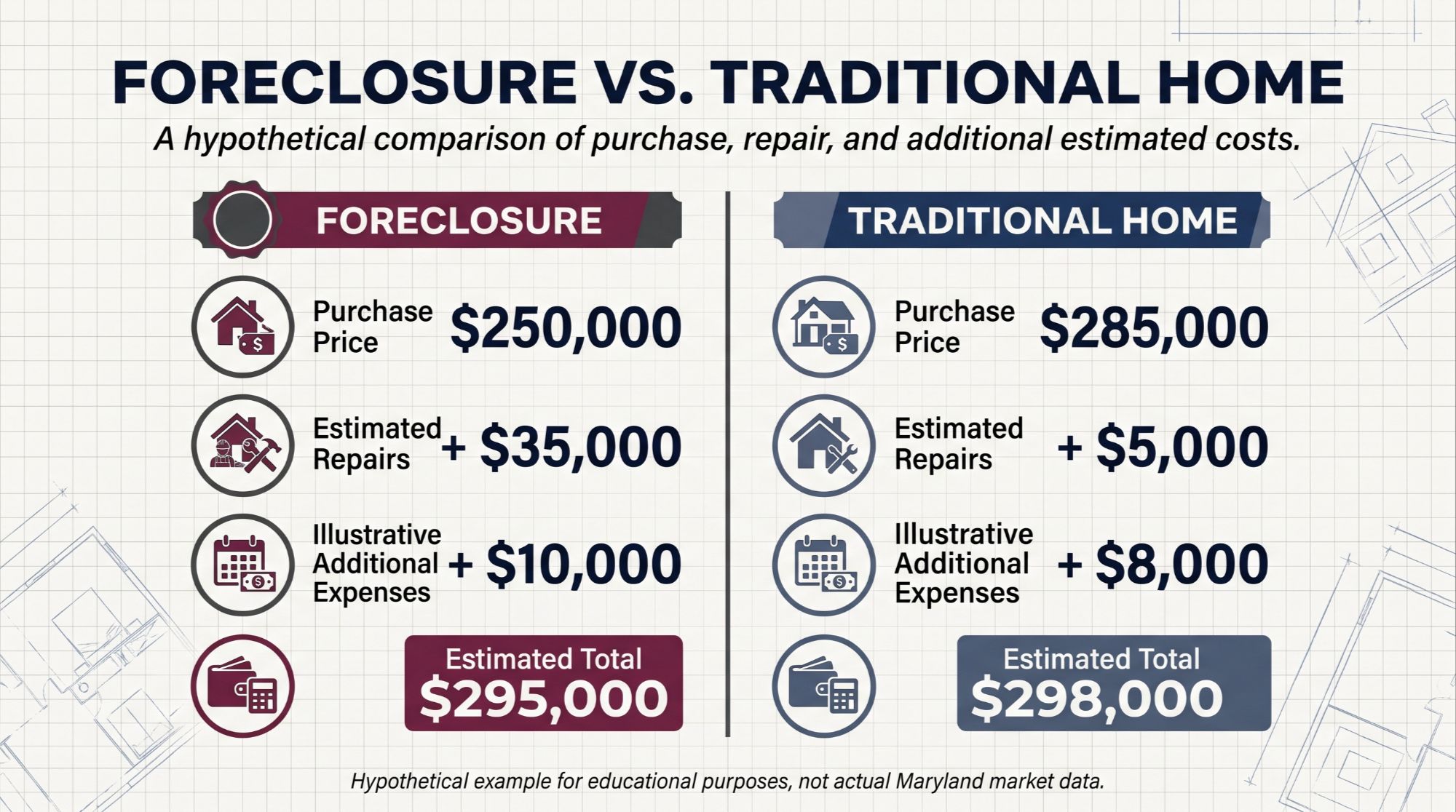
Illustrative example only. These are not actual Southern Maryland sale prices, repair estimates, or closing-cost averages. Financing costs, taxes, insurance, and other expenses are excluded.
Although the foreclosure costs $35,000 less upfront, the estimated overall difference is only $3,000.
Unexpected foundation problems, roof damage, plumbing repairs, or title expenses could eliminate that advantage.
To determine whether a foreclosure is worthwhile, compare the home's anticipated total cost with recent sales of similar properties in the same local market.
A contractor's evaluation and realistic repair contingency can help make that comparison more reliable.
Risks Buyers Should Understand Before Purchasing a Foreclosure
Foreclosures can involve complications that aren't always present in conventional transactions.
Property Condition and Limited Inspection Access
Some foreclosure properties have been vacant or poorly maintained.
Potential issues include water intrusion, mold, missing equipment, damaged plumbing, and deferred maintenance.
Auction buyers may have little or no interior access before bidding. Even with an REO listing, the seller may offer limited information about the property's history.
Whenever possible, arrange a professional inspection and obtain repair estimates before committing.
Liens, Title Issues, and Occupancy
A foreclosure sale doesn't necessarily resolve every potential title or occupancy issue.
Certain liens, easements, tax obligations, or other legal interests may affect the property depending on the circumstances.
Use Maryland property assessment and ownership records as a starting point, but don't treat those records as a substitute for a professional title examination.
If occupants remain in the property, buyers should obtain legal guidance about possession and applicable requirements.
Auction Deposits, Terms, and Delays
Maryland foreclosure auctions may require a deposit at the time of sale.
The amount, acceptable payment methods, deadlines, and responsibility for expenses depend on the published terms.
Court ratification and other post-sale requirements can also affect timing.
Never assume that an auction purchase can close on the same schedule as a conventional residential transaction.
Can You Finance a Foreclosed Home With a Conventional, FHA, or VA Loan?
Financing may be possible, but it depends on the property, lender, loan program, and transaction structure.
Conventional loans: Some bank-owned homes may qualify for conventional mortgage financing if the property satisfies lender and appraisal requirements.
FHA loans: FHA financing may be available for eligible properties that meet applicable standards. Homes needing significant work may require consideration of a renovation loan program.
VA loans: Eligible borrowers may be able to purchase qualifying foreclosure properties using VA-backed financing, subject to lender approval and VA property requirements.
Buyers can review the VA's official home loan information for program guidance.
An auction requiring immediate funds or a property with serious condition problems may not fit a standard mortgage transaction.
Before searching seriously, explore mortgage pre-approval and discuss property-condition requirements with your lender.
Pre-approval does not guarantee final loan approval or establish that a particular foreclosure qualifies.
How to Buy a Foreclosure in Southern Maryland Step by Step
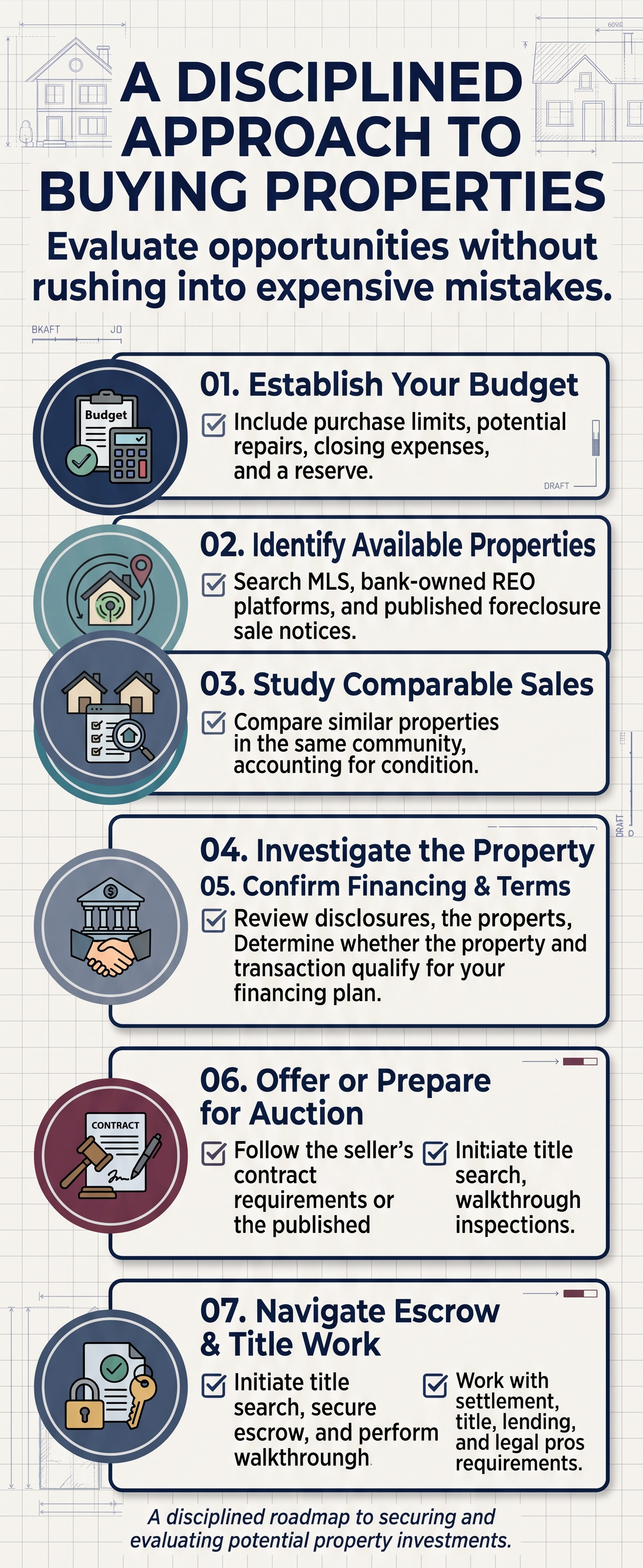
The goal isn't simply to purchase a foreclosure below its original asking price. It's to acquire a property at a total cost that makes sense for your budget, plans, and tolerance for repairs.
A thoughtful search can reveal opportunities, but it can also help you recognize when a conventional listing is the better choice.
Frequently Asked Questions
Can first-time homebuyers purchase foreclosures in Maryland?
Yes. First-time buyers can purchase foreclosed properties if they meet the seller's requirements and can arrange an acceptable payment method. Bank-owned homes may offer a more familiar buying process than courthouse auctions. Financing eligibility depends on the property and loan program.
Can you inspect a foreclosure before buying it?
Sometimes. Bank-owned properties may permit inspections, depending on the seller's contract and access restrictions. Foreclosure auctions may provide little or no interior access. Buyers should confirm inspection opportunities before committing.
Do you need cash to buy a foreclosure at auction in Maryland?
Not necessarily for the entire purchase price, but auctions commonly require an immediate deposit in an approved form. The remaining balance is due according to the published sale terms and applicable court process. Buyers should not bid without confirming how they will meet those requirements.
How long does it take to close on a foreclosed home in Maryland?
It depends on the type of sale. An REO purchase may follow a conventional contract timeline, while a foreclosure auction requires additional steps, including court ratification. Contested proceedings, title issues, or financing requirements can create delays.
Interested in exploring foreclosure opportunities without overlooking the potential costs?
The Southside Group Real Estate can help you compare distressed properties with traditional listings across St. Mary's, Calvert, and Charles counties.
Start by exploring available Southern Maryland homes and identifying properties that match your budget and purchase goals.
Whether you're considering a bank-owned home, a property needing repairs, or a conventional listing, understanding your options is the first step toward making a confident decision.
FROM OUR BLOG


Charles County Events This Weekend | November 19–22, 2026
Charles County events this weekend offer plenty of opportunities to connect with the community, enjoy local entertainment, discover holiday shopping, and explore activities throughout Southern Maryland. From November 19–22, 2026, residents and visitors can find networking gatherings, live performanc

St. Mary's County Events This Weekend | November 19–22, 2026
St. Mary's County events this weekend offer a wonderful mix of local history, live entertainment, art, outdoor adventures, vintage shopping, and community activities throughout Southern Maryland! From Thursday, November 19, through Sunday, November 22, 2026, residents and visitors can explore exciti
How to Avoid Overpaying in a Competitive Housing Market: A Southern Maryland Buyer's Guide
Buying a home is one of the biggest financial decisions you'll make, and when multiple buyers are competing for the same property, it's easy to feel pressured to offer more than you originally planned. In Southern Maryland, buyers searching in St. Mary's, Charles, and Calvert counties may encounter