
Receiving multiple offers on your home can be exciting, but deciding which offer to accept is not always straightforward. For homeowners navigating Southern Maryland multiple offers in 2026, the highest purchase price may not represent the strongest overall deal.
An offer with favorable financing, manageable contingencies, and a realistic closing schedule may provide more certainty than a higher-priced contract with additional risks.
Whether you're selling in St. Mary's County, Calvert County, or Charles County, understanding how to evaluate competing offers can help you protect your interests and move toward a successful settlement.
Here's what Southern Maryland sellers should know before making that decision.
Are Multiple Offers Still Happening in Southern Maryland in 2026?
Multiple-offer situations can occur in any market, but they are not guaranteed.
Buyer demand, available inventory, property condition, asking price, and location all influence how much competition a listing attracts.
In Southern Maryland, market conditions can vary considerably between communities.
A home in Lexington Park may attract a different buyer pool than a property in Leonardtown or Waldorf.
Even properties within the same community may receive different levels of interest depending on their features, condition, and pricing.
For sellers, this means the most useful information comes from recent comparable sales, active competing listings, and current buyer activity in the immediate market.
Countywide housing reports can provide helpful context, but they should not replace a property-specific pricing analysis.
Seller takeaway: Prepare your home to compete effectively without assuming that multiple buyers will automatically submit offers.
How to Position Your Home to Attract Competitive Offers
The groundwork for a successful multiple-offer situation begins before your property reaches the market.
Price your home using current comparable sales
An asking price should reflect the home's condition, features, location, and recent comparable transactions.
Pricing significantly above what the market supports can discourage showings. Pricing below market value solely to generate a bidding war can also be risky because additional offers are never guaranteed.
A local pricing analysis can help establish a defensible starting point.
If you're preparing to sell, you can begin by requesting a home valuation to explore your property's potential market position.
Prepare the property for buyer expectations
Buyers evaluate more than square footage and listing photographs.
Before listing, consider addressing visible maintenance concerns, improving lighting, cleaning thoroughly, and reducing unnecessary clutter.
The goal is to present the home's condition accurately while making it easier for buyers to understand its features.
Make the listing easy to evaluate
Professional photography, clear property descriptions, accurate disclosures, and practical showing availability can help interested buyers make informed decisions.
A well-organized listing experience can also reduce confusion when buyers are working within tight offer deadlines.
How to Compare Multiple Offers Beyond the Purchase Price
When multiple offers arrive, comparing only the purchase prices can lead to an incomplete decision.
A seller should evaluate the financial terms, contractual obligations, timing, and potential obstacles associated with each proposal.
Here are the major factors to consider.
Purchase price and estimated net proceeds
The highest offer does not always produce the highest estimated proceeds.
Buyer-requested closing cost contributions, repair credits, and other concessions can change the amount a seller ultimately receives.
Financing and buyer qualifications
A cash offer and a financed offer involve different requirements, but neither should automatically be considered better.
For financed offers, review the available pre-approval information, financing terms, and applicable contingencies.
VA, FHA, and conventional financing each have their own requirements. Sellers should evaluate the actual terms and supporting documentation rather than make assumptions based on loan type.
Earnest money deposit
An earnest money deposit demonstrates a buyer's commitment to the transaction, but the deposit amount alone does not guarantee settlement.
The contract determines how the deposit is handled and under what circumstances it may be returned or disputed.
Contingencies
Inspection, appraisal, financing, home-sale, and other contingencies may affect whether the transaction moves forward.
Pay attention to both the scope of each contingency and the deadlines for satisfying or removing it.
Settlement and possession dates
A buyer's proposed settlement schedule may be especially important when the seller is purchasing another property, relocating, or coordinating a move.
A practical closing date can sometimes be more valuable than a small difference in price.
Example: Comparing three competing offers
Hypothetical illustration only. These are not actual Southern Maryland market offers.
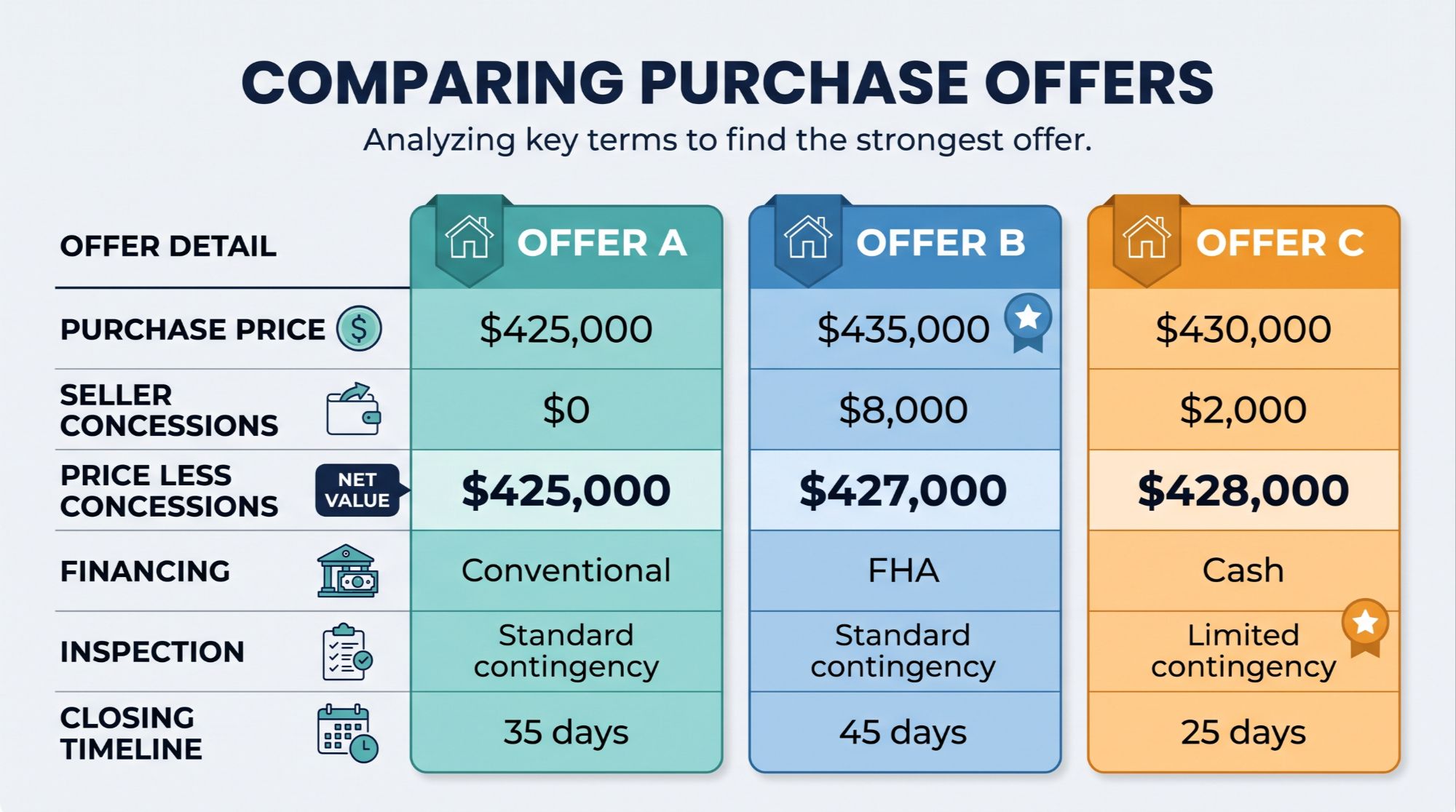
In this illustration, Offer B has the highest purchase price, but Offer C has the highest price after the stated concessions.
That does not automatically make Offer C the best choice.
Other closing costs, financing considerations, appraisal provisions, contingencies, and the seller's personal timeline still matter.
The right decision comes from comparing the complete contracts, not simply ranking the purchase prices.
Understanding Contingencies, Appraisals, and Escalation Clauses
Some of the most important differences between competing offers appear in the contract terms.
Inspection and financing contingencies
An inspection contingency may allow a buyer to request repairs, negotiate terms, or terminate the contract under specified conditions.
A financing contingency generally provides protections related to the buyer obtaining the financing described in the agreement.
Sellers should understand what each provision allows, when deadlines expire, and what happens if a requirement is not satisfied.
A shorter contingency period is not necessarily better if the buyer cannot realistically complete the required steps.
Appraisal gaps and above-asking offers
A buyer may offer more than the asking price, but the property's appraised value can become important when financing is involved.
For example, suppose a home goes under contract for $450,000 and the appraisal comes in at $435,000.
The $15,000 difference may require additional negotiations, additional buyer funds, or another resolution permitted by the contract.
An appraisal-gap provision may address how a buyer intends to handle that difference. However, sellers should carefully review any dollar limits, conditions, and financing implications.
An appraisal-gap promise is not the same as proof that the buyer has sufficient funds.
Escalation clauses in Maryland
An escalation clause is a contract provision that may allow a buyer to increase an offered purchase price when a qualifying competing offer exists, subject to the clause's terms and maximum amount.
For example, a buyer might offer $420,000 with a provision to exceed a qualifying competing offer by $2,000, up to a stated ceiling.
The actual calculation depends on the language of the escalation addendum and the competing offer documentation.
Maryland sellers should have their real estate professional review these provisions carefully before accepting an offer.
Escalation clauses can create additional complexity, particularly when competing offers contain different seller concessions or other financial terms.
A seller should not assume that the highest escalation ceiling necessarily produces the most favorable contract.
Should Southern Maryland Sellers Request Highest and Best Offers?
When several buyers express serious interest, a seller may consider requesting their highest and best offers by a specified deadline.
This approach gives interested buyers an opportunity to submit their strongest proposed terms for consideration.
However, a highest-and-best request is a negotiation strategy, not a guarantee of a higher sale price.
When an offer deadline may help
An offer deadline may be useful when there is substantial showing activity, several written offers, or clear indications of competing buyer interest.
It can establish an organized review process and reduce the need for repeated individual negotiations.
When waiting can create risk
A seller who delays responding to an attractive offer may lose that opportunity if the buyer withdraws or the offer expires.
Some buyers may also decide not to participate in a competitive bidding process.
For that reason, the timing of an offer deadline should reflect actual market activity rather than an assumption that more offers will arrive.
Keep the negotiation process organized
Your listing agent can help coordinate communications, track offer expiration dates, and explain the advantages and risks of different responses.
Maryland sellers should also understand that the terms of the listing agreement, applicable law, and brokerage obligations govern how offers are presented and handled.
Sellers should avoid making commitments to multiple buyers that could create conflicting contractual obligations.
Common Mistakes Sellers Make in Multiple Offer Situations
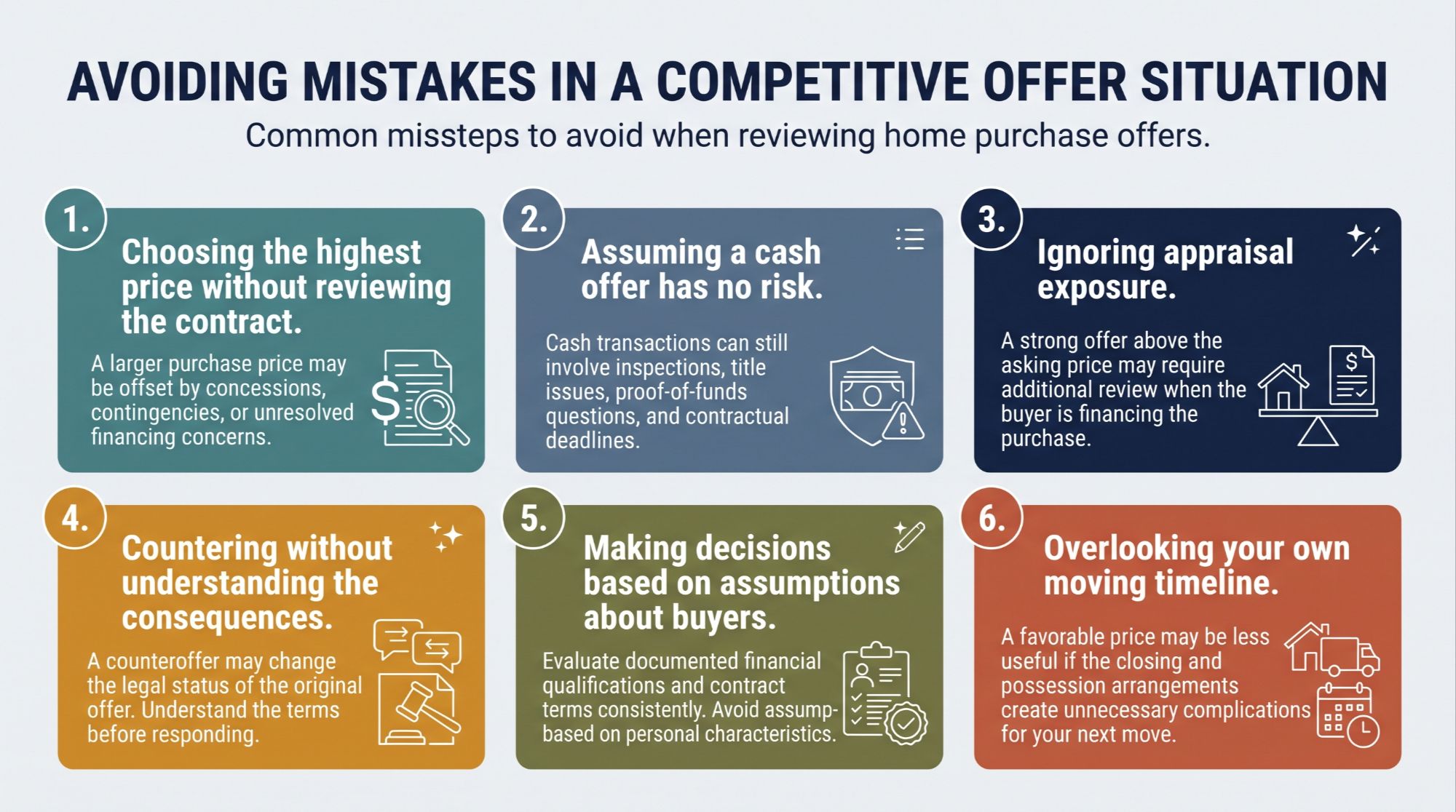
A clear decision framework helps keep the process focused on the terms that actually matter.
What Happens After You Accept an Offer?
Accepting an offer is an important milestone, but it does not mean the sale is complete.
Once the parties have a ratified contract, the transaction enters a period in which contractual obligations and deadlines must be managed carefully.
Track important contract dates
Your transaction may include deadlines for earnest money deposits, inspections, financing, appraisal, title work, and settlement.
Missing a deadline can create complications, so sellers should maintain an organized record of required actions.
Prepare for inspections and appraisal
Make the property reasonably accessible as required by the contract.
If inspection concerns arise, review the buyer's requests against the actual contract provisions before agreeing to repairs or credits.
For financed transactions, the lender may also require an appraisal and additional documentation.
Understand backup offers
A seller may receive interest from another buyer after going under contract.
Depending on the circumstances and applicable contractual terms, a backup offer may provide an alternative if the primary transaction does not close.
However, a backup offer must be structured carefully to avoid conflicting obligations.
Stay focused on settlement
Even after contingencies have been addressed, final lender approval, title requirements, document preparation, and settlement arrangements may remain.
Your listing agent, settlement professionals, and other appropriate advisers can help you understand the remaining steps.
The objective is not simply to win a bidding war. It is to select a sound offer and successfully complete the transaction.
Frequently Asked Questions
Does a seller have to accept the highest offer in Maryland?
Generally, no. Sellers can evaluate offers based on price, financing, contingencies, settlement timing, and other lawful considerations. Existing contractual obligations and applicable laws still apply.
Can a seller counter more than one offer at the same time?
Multiple-offer negotiations require care because counteroffers can create legal consequences. Sellers should discuss their negotiation strategy with their listing agent and obtain legal advice when necessary to avoid conflicting contractual commitments.
Should sellers accept an offer with an appraisal gap?
An appraisal-gap provision may help address a low appraisal, but its value depends on the contract language, the buyer's financial resources, and any applicable financing requirements. Review the actual terms before relying on it.
Can a seller accept backup offers after going under contract?
Backup offers may be possible, but they must be structured around the existing purchase agreement. Sellers should obtain appropriate professional guidance before signing another contract.
How long should sellers wait before responding to multiple offers?
There is no universal waiting period that works for every listing. Consider offer expiration dates, buyer interest, market activity, and the strength of the offers already received. A clearly communicated review schedule can help organize the process.
Selling Your Home in Southern Maryland?
If you're preparing to sell in St. Mary's, Calvert, or Charles County, The Southside Group Real Estate can help you understand your local market, prepare your property for buyers, and evaluate offers based on your selling priorities.
Start with a free home valuation or contact The Southside Group Real Estate to discuss your next steps.
FROM OUR BLOG

Golden Beach Real Estate Market Update | November 16, 2026
If you've been keeping an eye on homes for sale in Golden Beach, you'll notice that buyers have a relatively small selection to explore this week. With just four homes actively listed, two more under contract, and no properties currently advertised as coming soon, there isn't a long list of availabl

Long Beach & Calvert Beach Market Update November 12, 2026
The Long Beach and Calvert Beach real estate market update for November 12, 2026, brings a closer look at available homes, current asking prices, and pending activity in these two Chesapeake Bay communities in Calvert County, Maryland. Here's what the latest inventory means for buyers, sellers, and

Southern Maryland Housing Market Update November 12, 2026
Numbers to Know: Southern Maryland Real Estate Market Update for November 12, 2026 This week's Southern Maryland housing market update shows a noticeable shift. More homes are available, new listings are increasing, properties are taking longer to sell, and fewer homes are going under contract compa